Training and support
Live and online
Initial training before using TARA and ongoing support from the pedagogical team.
What it does, how teachers see it and who can use it at each stage.
TARA does not replace human connection. Its role is to offer support for thinking, sorting out situations, preparing conversations and accompanying educational decisions with more clarity, care and relational coherence.
Naming what is happening, identifying needs and looking at the situation more clearly.
Organising ideas, rehearsing ways of expressing yourself and thinking of more careful ways to open a conversation.
Encouraging educational responses, more empathetic relationships and safer environments for coexistence.
How teachers see it
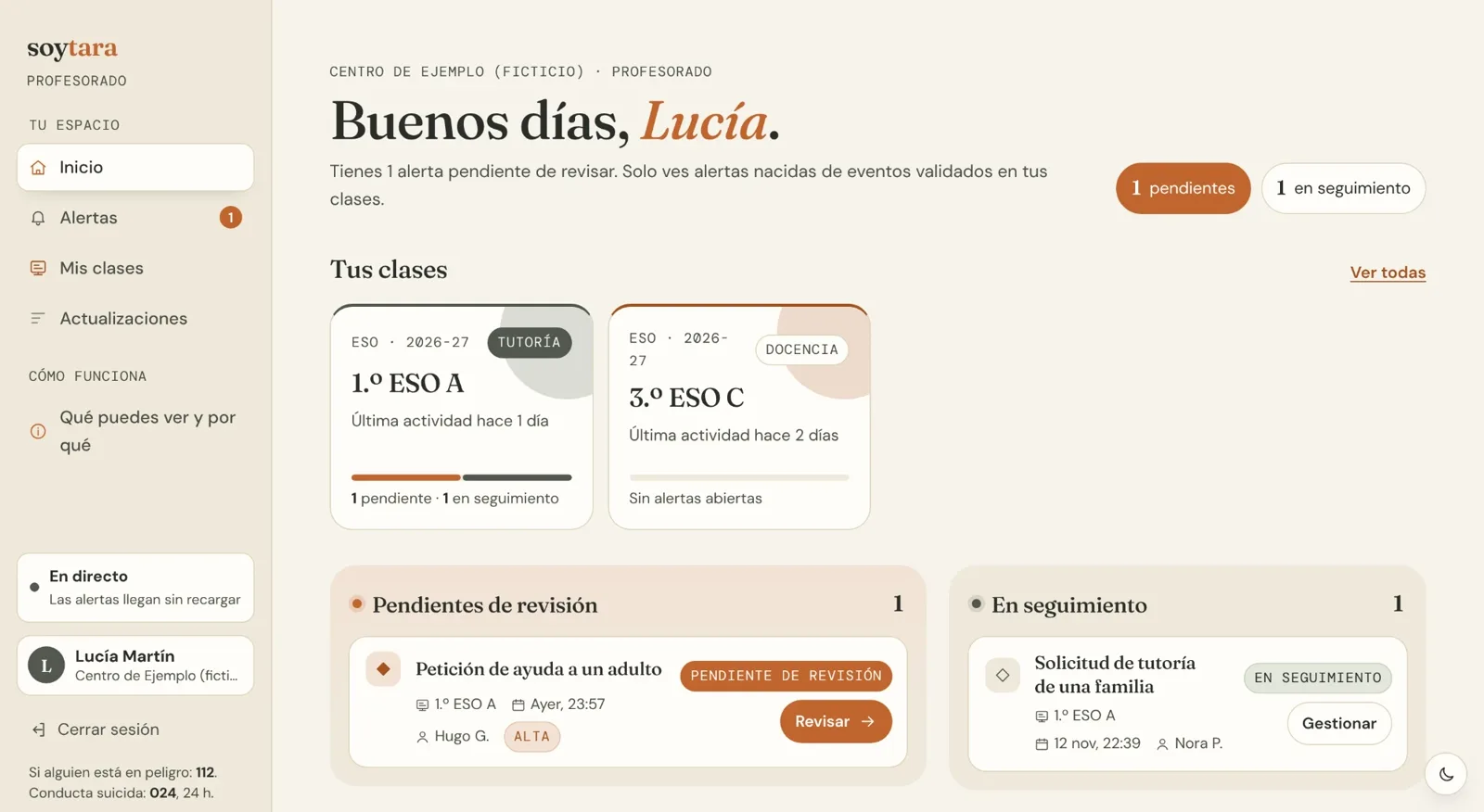
Each teacher logs in with their own account and sees their classes and what they have pending.
Stages and levels
| Who uses it | Early years | Primary | Secondary (ESO) | Upper secondary and vocational |
|---|---|---|---|---|
| 1 · School staffTeachers, tutors, guidance and leadership | ✓ | ✓ | ✓ | ✓ |
| 2 · FamiliesMothers, fathers and legal guardians, if the school decides | ✓ | ✓ | ✓ | ✓ |
| 3 · The whole class, with their teacherA classroom activity led by the teacher | — | ✓ | ✓ | ✓ |
| 4 · Students in small groupsIn pairs or small groups, guided by a teacher | — | — | ✓ | ✓ |
| 5 · Each student on their ownWith the school's supervision | — | — | ✓ | ✓ |
TARA grows from supporting adults towards guided experiences with students, and only at certain stages does it allow uses with more autonomy.
Training and support
Initial training before using TARA and ongoing support from the pedagogical team.
Protection
Protection and wellbeing criteria built in from the design stage, with the psychology team.
Privacy policy